STRAIGHT SHOOTER
It is a quintessential autumn morning, the sun warm on the skin, the air slightly cool and crisp as a cracker. An hour or so southwest of Minneapolis, the fields around Mankato, Minnesota have faded to a soft gold, a countryside so gentle and quiet you can hear the rustle of feathers as geese wing overhead in a lopsided vee.
At his picture-perfect ranch just outside of town, Glen Taylor is in his element. For a few hours, he's traded in his steel gray business suit for a plaid wool shirt, blue jeans and a pair of well-worn boots, and is happily bridling China Doll, a speckled Arabian. He smoothes her mane and murmurs sweetly in her ear. The farm kid back on the farm.
"My brothers and I used to play basketball in a barn just like that one," Taylor says a few moments later, nodding across the tidy front lawn at the horse barn, where bales of hay stack up among the rafters. "We had a hoop up on one wall and a small patch of empty floor. As we went through the winter and used the hay, the court got bigger and bigger."
You could say the same about Glen Taylor's career. And maybe his life. From an unpretentious upbringing on a western Minnesota farm, Taylor brought his work ethic and common sense to town and landed a job at a Mankato print shop. Then he parlayed that job into company ownership, eventually building a formidable printing enterprise that employs some 12,000 people and has made Glen Taylor a billionaire.
From business success came a turn at state politics, including a stint as Senate Minority Leader. And then Taylor took his wealth, his name recognition and his business acumen and directed it toward a new "side" business, ownership of the Minnesota Timberwolves National Basketball Association franchise. He and a handful of limited partners purchased the team for $88 million in 1995. He followed up that purchase with the Minnesota Lynx, the WNBA franchise, in 1998.
Today, 58-year-old Taylor ranks as one of the wealthiest and most influential citizens in Minnesota, a major employer, a generous benefactor, and perhaps the only guy who could keep the Minnesota Timberwolves from leaving town. "I owe a lot to this community," Taylor says of the purchase. "I had the resources and the will to make it work.
"It wasn't a long-term plan, it wasn't a dream," he adds. "Like most business people, I had probably thought, 'Why would anyone want to buy a sports team and lose $5 million? But it was the challenge. That's why I do about everything. Can I get this thing and make it profitable and make it fun?"
In a word, yes. Spend some time with Glen Taylor, and you come to decide that he can probably make anything profitable and fun. The printing industry, politics...his success in those fields may be little more than coincidence, really. Glen Taylor likely would have made his mark--made his billion--in whatever field he entered.
"I've always been like that," he suggests. "In first grade, I figured out teachers kept score, and from that time forward, I always wanted to know the highest score, and if it was mine. I needed to be at the front of the line. Half the time, I didn't even know what the line was for--but I wanted to be first to see where we were going."
And perhaps most surprisingly, he manages to be first with an almost unnerving humility and candor. Taylor is an enigma, a Wall Street mind who yearns for a weekend of farm chores. A man who explains his leadership skills as "a God-given gift. It's not one of those things you take credit for." A man who has the resources to build up walls of privacy, but instead lays his personal life out on the table for all to see.
"People are successful, and then all of the sudden they start believing that they're special," he scoffs. "They almost make up stories about how smart they are, how their success was some kind of magic." He wrinkles his forehead into deep furrows. "Well, how is that helpful?
"I see myself as Glen," he adds. "I've been fortunate, but that doesn't make me better. The secrets of success aren't secrets. They're common sense things--you thank people, you listen to people, you show respect. And you work harder at it."
Only those who live in the Mankato area or happen to run their own printing companies have heard of the Taylor Corporation--maybe. Taylor Corp. maintains an exceptionally low profile, mostly because it operates its facilities under a variety of names, many of them acquisitions. Taylor Corp. companies come with names like Web Graphics Midwest, Litho Tech, Ad Graphics, LabelWorks, Precision Press...not exactly the stuff that grabs the attention of Forbes.
"That was a conscious decision," explains Taylor. "We want our employees to see themselves as part of a small company where they know their customers and take care of their customers. They don't work for Taylor Corporation, one of 12,000 employees. They work for Fine Impressions, 250 people, where they feel they can really make a difference."
There's something to the strategy, because those employees of those small companies have helped Taylor Corp. quietly grow into the 12th-largest printing company in the U.S., with operations in 17 states, three Canadian provinces, Mexico, the United Kingdom, the Netherlands, Sweden and Australia. Though the privately held company doesn't release sales figures, industry experts estimate annual revenues at nearly $1 billion. Glen Taylor owns 89 percent.
If you've ever ordered wedding invitations, it was probably printed at a Taylor Co. facility. The company claims 90 percent of the formal wedding invitation market, work that boasts some of the highest profits margins in the business. Such specialty printing is the company's bread and butter. Along with wedding invitations and napkins, Taylor Corp. dominates the market for customized 3M Post-It Notes, W-2 forms, company letterhead and business cards.
It all began with a Mankato print shop. Now known as Carlson Craft, the company printed wedding invitations, a business which, in the late 1950s, offered few choices: Customers could choose from stock in white or ivory, text for Catholics or Protestants. Like Henry Ford's Model T, you could get ink in any color, as long as it was black.
In 1959, in walked 18-year-old Glen Taylor, an earnest college freshman from Minnesota State who needed a part-time job to support his wife and young daughter. Bill Carlson hired him on the spot. Taylor took a shine to sales and marketing; when he completed his degree in 1962--a year early--he joined Carlson Craft full time. Eschewing traditional practices and listening to his customers, Taylor urged Carlson to offer a variety of inks, papers and text choices for wedding invitations, and speed up turn-around time.
"We're not at all the same," Taylor says of his first employer. "He's very conservative; I thought I knew everything. So we balanced--everything I wanted to do, he cut by a third, and then it was successful. His experience and wisdom, and my enthusiasm and risk-taking nature, made for a successful business."
Taylor studied math, physics and social studies in school--he had planned to become a teacher--but proved a natural in the business world. He figured out the way to make money was through ownership, so he made a deal with Carlson: if he could find a new way to increase profits, he'd get a cut of the take. The enterprising Taylor then devised a machine that could eliminate a step in the printing of wedding napkins, an efficiency that saved about a penny per piece. And Glen Taylor was on his way to his first million.
"I made mistakes in business, I just was fortunate to make them early," Taylor acknowledges. He learned the importance of balance, for example--not letting marketing get ahead of operations, or technology get ahead of people. "Let any one area get too far ahead of another, and it can kill a company," he says.
And he learned the value of good advice. "I quizzed everyone--suppliers, acquaintances, business people I'd meet at a party," he explains. "If you're sincere, if you're respectful, almost anyone will sit down and answer your questions. You don't have to make a lot of mistakes if you ask a lot of questions."
By the 1970s, Taylor had purchased a majority ownership in Carlson Craft, paying Bill Carlson more than $1 million for the business over 10 years. Then he began acquiring other small printing companies, first relying on owner financing, then later buying them outright with cash.
Taylor has built his empire unlike most others--with virtually no debt. "Even today, we borrow very, very little," he says. "We're a very conservative bunch. It comes down to why this company is here in the first place, and that's to provide security and opportunity for our employees.
"And if you believe that, you don't do what a lot of these guys do," he continues, his blue eyes flashing bright and steely. "You don't bet. You don't bet the security of your company, just so you can feed your own ego or make a big pile of money. Sure, a bunch of people get rich, but then what happens to everyone else?
"If I borrow, I'm letting a banker dictate how my business is run. And I'm not going to do that to myself or the people of this company."
Many of the companies Taylor purchases are struggling financially; Taylor Corp.quickly turns them around with an infusion of capital, its economies of scale and its management expertise. Taylor avoids unionized shops. "I'm not against unions per se," he explains, aware that he's on a touchy topic. "I understand that there are certain situations where they serve a purpose, where employees need someone looking out for them. In the Legislature, I helped some unions, like the highway patrolmen. The state was their employer, and I wasn't convinced the state was looking after them.
"But here, I feel employees shouldn't have to go to other representation to have their needs met," Taylor continues. "We should meet those needs. I don't have any problem with employee groups, or with in-house unions like we have in Canada. Some people have a difficult time speaking out on their own. But the problem with most unions is they aren't just representing our employees; they're representing employees in other companies in the same industry. So they end up bringing their problems into our company."
Taylor Corp., he says, has very little turnover. "So it's more than a work place for me. It's more than watching people mature in their careers. It's watching them mature in life. I've watched my first group of managers raise their children, and now those children are working here." The company was one of the first in Minnesota to open a company-operated and subsidized day-care center.
Like Mr. Carlson, Taylor hires Mankato students, from Minnesota State and the local technical college. "Many companies will tell you their biggest limitation is finding good employees," he remarks. "We hire students, keep in tune with their work ethic, and develop leaders from within." When he acquires companies outside the area, Mankato-bred managers often are sent to fill the top job.
"By staying here, we continually have the resource of hard-working, talented people," he had explained on the way to the ranch, steering down a two-lane highway in North Mankato, pointing out new Taylor Corp. operations sprouting out of farm fields like volunteer corn. But there's more. There's something about the agrarian sensibility, the hard labor written across this landscape, that soothes Taylor. "It's Mankato," he says with a gentle grin. "In Chicago, you can lose yourself. In Mankato, you can't."
Taylor was born the second of seven children on a 160-acre farm about 60 miles west in Comfrey, the same farm where his father grew up. "We weren't wealthy, but as a kid I didn't know that," he says. The family grew a good share of its own food, and raised corn and soybeans as cash crops, oats and hay to feed the livestock.
"In one sense, I was very naive about business, but I actually grew up understanding the basics, because I literally saw it in action," Taylor remarks. "We needed the cash crops to make the payment to the bank. We'd collect eggs, take them to town and get cash, then use the cash for farm supplies. It was all right there for me to see."
Taylor loved the animals--obvious even now as he strokes a random farm kitten intent on strutting across the picnic table and any available lap--so his chores were caring for the horses, cows and chickens. His other love was sports, any sports. "My father did a wonderful thing," Taylor says, staring down at his lap with a far-away smile. "He had a policy that if you worked hard, did your chores and did well in school, you could participate in sports. That was unusual in a farm community."
Taylor kept up his grades, his chores and a feverish athletic schedule: football in fall, basketball in winter, then track, then baseball in spring. In the evenings, he and his brothers would play "work up," a type of pick-up baseball, or shoot hoops in the barn loft. Taylor became the quarterback of the football team, a starting guard for basketball, and a Merit Scholar and the class salutatorian, too. "I loved sports," he says with an almost painful earnestness. "It was a really nice life."
Yet Taylor's daily existence soon veered off in a different direction, rerouted by a pregnancy and Taylor's subsequent marriage at age 16 to his first wife, Glenda. The couple eventually had four children before divorcing in 1990. (He married his second wife, Bonnie, this summer.) It's all part of Taylor's open-book life, which he lays wide open for strangers. Ask why he didn't run for governor, and he responds with a startling, "To save my marriage. I was too late, but I'm glad I tried." A business feature about Taylor in the Minneapolis Star-Tribune included so many intimacies it could've run in People magazine.
"I allow that to happen," Taylor says of his publicized personal life. "No, it's not the public's right to know. But you get to certain positions, and the public is going to want to know. Besides, I'm that way with my employees--we all talk about our kids, our problems--so I'm that way with the public, too. That's the person I am, and I'm not going to change that."
For all his frankness, Taylor was an unknown entity outside of Mankato when the local Jaycees encouraged him to run for the Minnesota Legislature in 1980. He served as a state senator through 1986, including a two-year term as Senate Minority Leader.
"I don't mind saying I was good at it," he says. "But I didn't like it. I could so easily see how things could get done, or get done better, but politics always got in the way of a good solution. I was able to accomplish a lot of things by taking my name off a bill. Somebody else would get the credit, and I'd get the results."
Taylor launched a brief bid for governor in 1990, but quickly withdrew for personal and political reasons. "When I ran for the Senate, I had the luxury of not promising people things. I don't know if I could've done that running for governor."
Of course, Taylor's riskiest political move these days revolves around the rosters and salaries of the Minnesota Timberwolves. "You know, the Timberwolves are not a big company," says Taylor shaking his head. "When I purchased the team, it never occurred to me the level of attention that would be focused on me. It's so out of proportion."
Some said the same of the much-publicized six-year, $126 million contract the Timberwolves signed with prodigy Kevin Garnett in 1995, the fattest deal in the history of professional team sports. "(General Manager) Kevin McHale said he had the ability, and I saw he had a gift. I watched him with the team, his eyes focused with absolute intensity on the coach. And he's a kid who probably didn't need to listen. He has the people skills to be a leader. That's why I paid that money."
No one really expected Taylor to buy the Timberwolves in the first place, not even Taylor. Because of his business and his political experience, he was brought in to mediate the deal for another party. "By the time I got there, I saw that deal couldn't be put together," he recalls. "But I also got a lot of information and saw that there was a way to run the team and not make it a money loser."
So far, his hunch has been correct. Since the purchase, the team enjoyed its first-ever winning record and three straight post-season appearances. Garnett was named an NBA All-Star, and the team's first starter in an All-Star game. Attendance, sponsorships and profits are all way up.
Perhaps just as important to Taylor, "We want this team to be good for Minnesota. Some teams will take a Dennis Rodman. We won't. Team play is important. Role models are important. We want to win, but we won't do it at any cost."
He says this without sounding preachy, and you get the feeling those kind of life lessons really mean something to Taylor. Maybe it's the latent teacher in him. Maybe it's the farm kid whose parents taught him the importance of responsibility and hard work and rewards. Maybe it's the teenage father who, instead of playing sports, figured out a way to succeed in school and work a couple of jobs to feed a family, and even find a career at which he could excel.
"I tell my kids, 'Don?t measure your dad's success on how wealthy he is,'" Taylor says, gazing at the scuffed toe of his boot. "'Measure him on how well he equates with other people.'"
His evolving role at Taylor Corp. reflects that. "I'm a teacher today--I talk and meet and share with our employees," he says. "Eventually, I'll do less of the day-to-day, and more of the motivating and planning, and more customer relations. I don't know that I'll ever actually retire. I'll retire from politics or this or that, I'll phase out of certain roles, but I think I'll be there a long time."
And he'll stay connected to the classroom. "Oh, I thoroughly enjoy going to schools and speaking with the kids. Young people are very stimulating. They'll ask anything!" Unlike many executives who demand a roster of questions ahead of time so they can carefully plan and prepare their answers, Taylor thrives on the challenge, the tough question. Even during this interview, he answers inquiries like a game show contestant, blurting out his responses as quickly as he can, then looking at you hard to see if you're satisfied or wanting for more. "One of my best presentations is that kind of question-and-answer format where they ask me something and I have to answer on the spot," he reports. "I'm always curious what I'm going to say."
Just then, Taylor's assistant, Linda Danielson, wheels up the driveway of the ranch, crunching gravel. She's there to remind Taylor of his schedule, of an appointment back at the office in an hour. He duly nods, then invites everyone over to a pen to see the pigeons he's raising, a unique breed of birds that flip and spin as they fly. Soon he has them soaring over the rooftops, these magical birds, hard-wired to circle in unison and perform their remarkable acrobatics against the azure Minnesota sky. Taylor beams at the sight, and at the oohs and aahs of his spectators.
It's clear what Taylor really wants to do, along with the teaching and consulting, is spend more time on the ranch. As he heads toward the house, he fiddles with this, futzes with that, talks with his niece about the man coming to do something with the horses, inquires about the ranch's supply of kitten food. Next weekend, he says, he's going down toward the Minnesota/Iowa border, where he owns some 7,000 acres of farm land, to "combine"--run the machinery that harvests the crop.
"To me it's like vacation," he says. "It's beautiful. It's just you, with the wind and the sun and the wildlife. And it's the harvest--the culmination of what you've worked for, the results and rewards of all your hard work." But right now, urges Danielson, it is time to go. Taylor finally excuses himself, then dashes inside to change out of his ranch clothes and prepare for his meeting.
When you see him a few minutes later, the billionaire in the business suit is back out in the farm yard, cooing with his pigeons, enjoying his harvest.

CEO profile
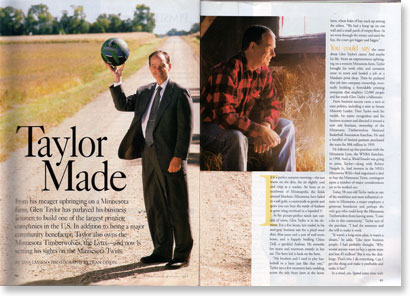
Client: Northwest Airlines WorldTraveler
Project: One of many profiles of business and entertainment leaders I've written for in-flight magazines.
©Meredith Corporation. All rights reserved. Any use of this text, in whole or part, without written permission of the publisher and author is prohibited by law.
Magazine Writing Samples

|
Isle Royale National Park |

|
Rafting the Rogue |
|
<b>Freediving</b> |

|
Slow Rides |

|
Dr. of Dirt |

|
Hiking Mt. St. Helens |
|
Backcountry Skiing |
